VocalForge
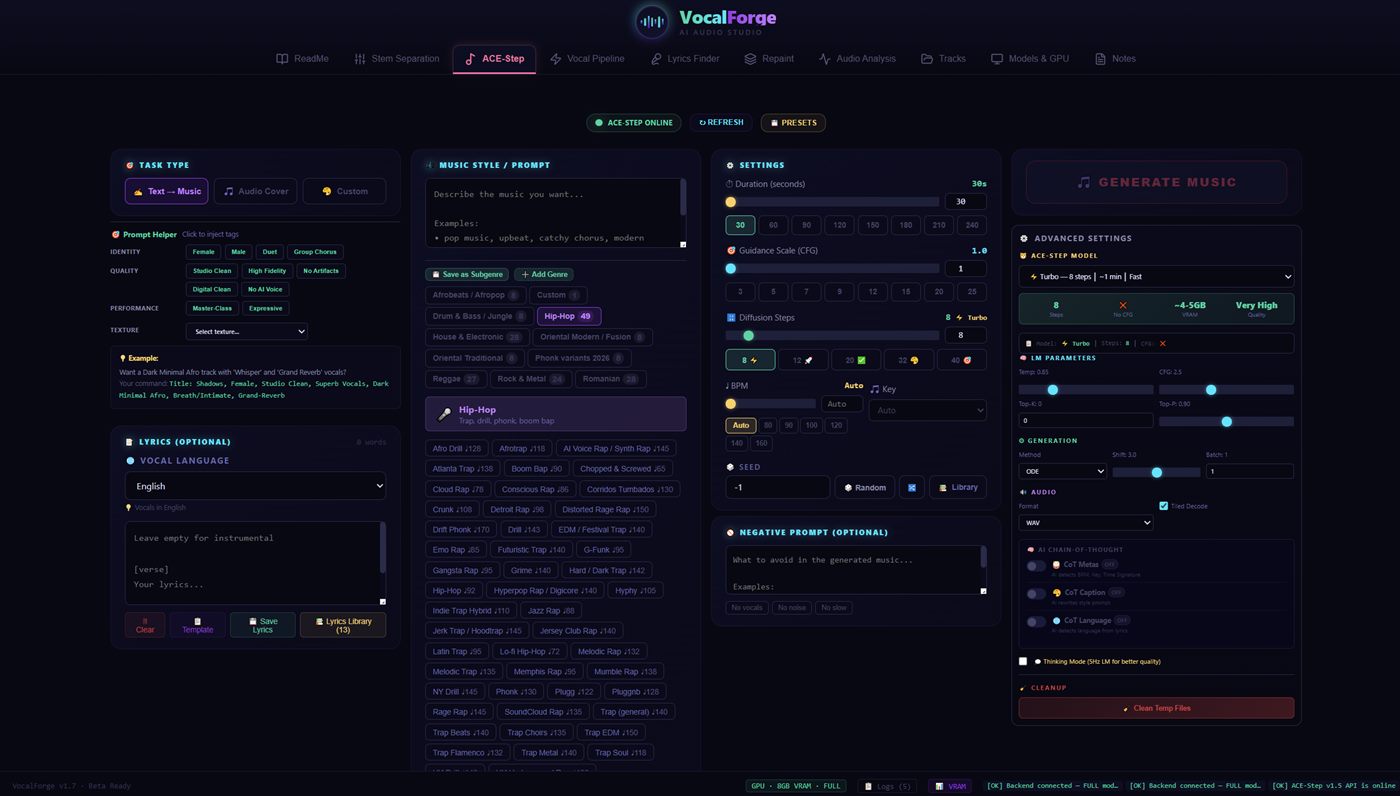
A music production studio that runs on your own GPU. Type a prompt, get a track, pull it apart into stems, then mix.
The problem
Every hosted AI music tool works the same way: upload your audio, wait in a queue, pay per generation, and hope the service still exists next year. For anything longer than a demo that is a bad deal, and it means handing your unfinished tracks to someone else's servers.
I wanted the opposite: a local app where the model runs on my machine, the files never leave the disk, and there is no credit counter.
What it does
- Turns a text prompt into a full song with ACE-Step v1.5, including vocals and instruments.
- Splits any track into stems with BS-RoFormer, so a generated idea can be re-arranged.
- Keeps a project folder on disk with every take, so nothing is hidden in an app database.
How it is built
A Python application with PyTorch and CUDA for the model work, packaged so it can be installed on Windows without a Python setup. Model weights are pulled once and cached locally; after that the app is usable offline.
The hard part was never the interface. It was memory: generation and stem separation both want VRAM, and running them back to back on a consumer card means being careful about what stays loaded and what gets unloaded between steps.
What I would change
Batch rendering is the obvious next step: queue ten prompts, walk away, come back to ten takes. After that, better handling of long tracks, since a single generation still has a length ceiling.
It is MIT licensed and developed in the open, so the commit history is the honest version of this page.